Morning could be hectic and harried for us- if we had to get everyone washed, dressed, fed, bundled up, out of the house and to school, daycare, work on time. They could be, but they're not, because we don't HAVE to be anywhere but right where we are.
This morning, when I felt obliged to give the baby an impromptu bath to wash the fistfuls of crusting-in mush and browning banana smoosh out of his hair, and the three year old decided to strip naked in the hall and take a running dive into the tub (no one in my house can stand missing out on a bath) I felt just a little put out. This wasn't on the schedule for the morning. But they're so cute, you know, so sweet. How can you stay grumpy with two little ones in the tub? All those bubbles and splashes, soapy clean smells and giggles. When the nine year old decided to join in the fun it just felt perfectly, well... perfect. Two little ones in the tub, warm and shiny, a big one perched in the corner, serenading (guitar practice without threats or shouting, check!) them with his entire play list while they danced and laughed, well, I was just glad to be home, free to enjoy such a lovely unscheduled and unplanned moment.
How many of those moments would be missed if we were caught rushing off to our important days elsewhere? How sad would it be if a baby's 6-grain hairdo were enough to start everyone's day off wrong (too rushed, late for school, late for work)? Those moments, simple and unstaged, are the ones that fill our family memory-bank, easy and quick to pull out on rainy days and hold on to during troublesome times. And so grateful are we, to be present here, filling our bank with memories we share, gathering moments of grace together.
Showing posts with label homeschool. Show all posts
Showing posts with label homeschool. Show all posts
Thursday, January 7, 2010


Monday, August 24, 2009
Brown Boxes
A goodly stack of them were waiting for us when we came home from a long weird weekend in the mountains. It's our favorite time of the school year- the end of summer, with last minute desperate dashes for fun all intertwined with school year plans getting more and more detailed, flushed out, projects and field trips in the works, book lists for the library getting compiled. Shelves being organized and reorganized. And boxes. Lovely brown boxes arriving in the mail, full of the things that mean school to us- some math workbooks, sometimes, sure, but a big stack of blank lesson books to fill with beautiful pictures and examples of our learning, new packages of colored pencils and beeswax crayons, lots of books to read and absorb, some games to play, a year's worth of "work".
I just realized about five minutes ago that I have a whole order, those math workbooks, three science kits, and a writing program, that I didn't put through yet! Wow! I tried, there was some problem, it slipped my mind. Oh well, I'll do it now and they'll be here eventually. It's not as if we're lacking school materials to get started with!
I just realized about five minutes ago that I have a whole order, those math workbooks, three science kits, and a writing program, that I didn't put through yet! Wow! I tried, there was some problem, it slipped my mind. Oh well, I'll do it now and they'll be here eventually. It's not as if we're lacking school materials to get started with!
Monday, July 20, 2009
lower case learning
I have a new blog, just for school stuff. That's why I started this one, of course, to keep all the homeschool ideas and curriculum plans organized, but it hasn't worked out that way. This is more about our lives and how we're figuring it all out than just about school- although when you homeschool I'm not sure you ever really aren't "doing school". Anyway- the new blog is called lower case learning and it is just school stuff. Really.
If you want to know the minutiae of our lives, you're in the right place. If you don't really care about that, or you're just dying to know exactly how our school days are structured, how many chapters of which book he read, how many science projects we did, or how our nature study is progressing- well, go there!
In either case, Welcome, and I'm happy to meet you and share these conversations about life, kids, and learning (theirs, and ours)!
If you want to know the minutiae of our lives, you're in the right place. If you don't really care about that, or you're just dying to know exactly how our school days are structured, how many chapters of which book he read, how many science projects we did, or how our nature study is progressing- well, go there!
In either case, Welcome, and I'm happy to meet you and share these conversations about life, kids, and learning (theirs, and ours)!
Thursday, July 9, 2009
Nature Study 1B Wasps
 Following up on our first Handbook of Nature Study lesson, we learned a little bit about wasps this week. Wasps are related to bees, but are not hairy like bees are. Wasps are solitary or social- those are the ones that build those paper pulp nests, like the one we saw on the slide the other day. Only the females have stingers. Some live on nectar, but others are omnivores, and eat carrion along with their sweets. Some wasps are parasitic, and they lay their eggs inside caterpillars, then when the eggs hatch, they eat the caterpillar from the inside out. Totally awesome, apparently. We did all agree that using parasitic wasps for pest control was way cooler than using toxic pesticides. Though I guess we don't want close encounters with either form of insect control!
Nature Study 1A Cottonwood
 Cottonwood Seeds. Photo from Land Arts in an Electronic Age.
We learned a little bit about Cottonwood Trees this week, after seeing a little farm COVERED in the fluffy cottony spiderwebby seeds, and seeing them at the Ahtanum Mission. Avery was interested to find out that Cottonwoods have light, flexible wood, often used to make those round cheese boxes, matches, paper, cheap plywood, snowboard cores, and perhaps most excitingly, the "bones" of Buster, the crash test dummy on the TV show Mythbusters! Apparently cottonwood breaks under the same pressure as human bones. Good to know, good to know. Another interesting thing about cottonwoods is that they can sprout roots from buried limbs and trunk (and vice versa) making them good at holding sand dunes, and one of the few trees able to survive a sand dune existence.
Also, cottonwoods are Poplar type trees, and like to grow in wet areas. Around here they are found down in the little valleys and canyons along stream banks.
Monday, July 6, 2009
Nature Study 1
We started our new Nature Study program today. We're using Anna Botsford Comstock's The Handbook of Nature Study, and the guidance and some of the ideas from The One Hour Challenges at this website, plus our regular nature science stories, like these, and these, as well as made up ones and Native American stories.
 Avery's drawing of a Clover flower. It doesn't show up well in the picture, but in his book it is sweet. Diminutive, but isn't clover, really?
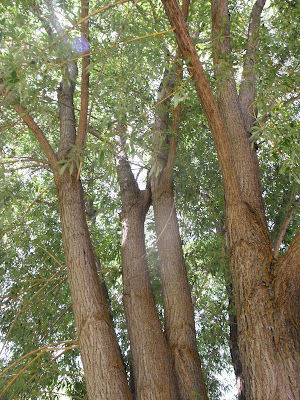 We had a picnic under this tree. What a great way to start a nature study outing!
 One of the original old apple trees still growing and producing on the Mission grounds.
 I think this is the seedpod of an American Sycamore tree. There are several at the Mission, providing beauty and shade to the park grounds.
 Wasp nest under the slide ramp. The boys watched closely for some time.

Miles' nature book drawing. He finished pretty quickly then spent some time moving piles of dirt around and poking them with his apple wood stick.

My page. We were sitting directly under one of those ancient apple trees, so it seemed natural to draw that. Ummm... not that I'm a fabulous artist or anything, but it's fun to all sit and draw together. And we were using these cool Lyra Aquacolor crayons, which draw nicely like rich, soft crayons, then magically turn into a watercolor painting when you brush with water!
 Avery's drawing of a Clover flower. It doesn't show up well in the picture, but in his book it is sweet. Diminutive, but isn't clover, really?
 We had a picnic under this tree. What a great way to start a nature study outing!
 One of the original old apple trees still growing and producing on the Mission grounds.
  I think this is the seedpod of an American Sycamore tree. There are several at the Mission, providing beauty and shade to the park grounds.
 Wasp nest under the slide ramp. The boys watched closely for some time.
Miles' nature book drawing. He finished pretty quickly then spent some time moving piles of dirt around and poking them with his apple wood stick.

My page. We were sitting directly under one of those ancient apple trees, so it seemed natural to draw that. Ummm... not that I'm a fabulous artist or anything, but it's fun to all sit and draw together. And we were using these cool Lyra Aquacolor crayons, which draw nicely like rich, soft crayons, then magically turn into a watercolor painting when you brush with water!
Our two topics for further study are wasps and cottonwoods. We'll spend a bit of time this week finding out about those things.
Thursday, April 23, 2009
Farmgirl's ABCs
I just saw the cutest idea for making the alphabet personal and real- it's beautiful and a great way to encourage your kids (and yourself) to pay atention to the world around. We're going to get started on our own version right now. Take a look here: http://localfoodblog.blogspot.com/2009/04/farmgirls-abcs.html
Only we don't have a farm or any girls, so ours will just be called "ABCs All Over the Place" or something like that. Enjoy!
Only we don't have a farm or any girls, so ours will just be called "ABCs All Over the Place" or something like that. Enjoy!
Wednesday, April 22, 2009
Organization::Homeschool
Middle of the night nursing the baby and thinking about organizing school stuff, I came up with this great idea. W ell, it's not implemented yet, so I'm not certain it's brilliant, but it seems to solve at least some of our problems: wasting school time running up and down the stairs to get supplies, having to carry stacks of stuff back downstairs again at the end of the day, my refusal to turn the main living areas of our little house over to plastic bins and utility shelving, the boys' difficulty with self-scheduling.
I already print off for Avery a schedule each week, so that he can cross off each lesson as he completes it, but he seems to need something more... physical, maybe.
So here's my idea: it hinges on these great, sturdy, big baskets from IKEA. We have one already, and I love it, though it's just full of play instruments right now. $19.99 for another big, matching basket is a small price to pay for a workable homeschool system!
First I thought I could just put each day's work in each basket, but I already do a variation of that, and I think sometimes seeing that big stack is just too daunting. I want school to be easy to start, easy for the boys to be able to find their next task, easy to keep materials for each lesson together, easy to take the lesson around the house so that work can happen while I'm folding laundry, nursing, cooking, sewing as easily as at the dining room table. Now I'm planning to sew up a BUNCH of simple drawstring bags, like these bandanna bags, so that each lesson can go in it's own bag, in the basket.
I could easily label the bags, or maybe create magnetic labels to slip in the bags, so that as each lesson is completed the kids can put the label up on a magnetic chart. I like being organized, but I'm thinking labels might be overkill. I'm in the process of making our daily chore lists into a magnetic chart, so maybe I'm just confusing these ideas into some sort of Franken-school-monster too complicated to function well in the real world. I'm aware of my problems, you don't even have to say anything. Really.
Anyway, I'm hopeful for this system, attractive baskets I won't mind having upstairs but are easily moved downstairs if space or company dictate it, an easy way for the kids to choose appropriate activities, and help themselves organize their days, at least a little bit.
How do you organize your home school?
 ell, it's not implemented yet, so I'm not certain it's brilliant, but it seems to solve at least some of our problems: wasting school time running up and down the stairs to get supplies, having to carry stacks of stuff back downstairs again at the end of the day, my refusal to turn the main living areas of our little house over to plastic bins and utility shelving, the boys' difficulty with self-scheduling.
I already print off for Avery a schedule each week, so that he can cross off each lesson as he completes it, but he seems to need something more... physical, maybe.
So here's my idea: it hinges on these great, sturdy, big baskets from IKEA. We have one already, and I love it, though it's just full of play instruments right now. $19.99 for another big, matching basket is a small price to pay for a workable homeschool system!
First I thought I could just put each day's work in each basket, but I already do a variation of that, and I think sometimes seeing that big stack is just too daunting. I want school to be easy to start, easy for the boys to be able to find their next task, easy to
 keep materials for each lesson together, easy to take the lesson around the house so that work can happen while I'm folding laundry, nursing, cooking, sewing as easily as at the dining room table. Now I'm planning to sew up a BUNCH of simple drawstring bags, like these bandanna bags, so that each lesson can go in it's own bag, in the basket.
I could easily label the bags, or maybe create magnetic labels to slip in the bags, so that as each lesson is completed the kids can put the label up on a magnetic chart. I like being organized, but I'm thinking labels might be overkill. I'm in the process of making our daily chore lists into a magnetic chart, so maybe I'm just confusing these ideas into some sort of Franken-school-monster too complicated to function well in the real world. I'm aware of my problems, you don't even have to say anything. Really.
Anyway, I'm hopeful for this system, attractive baskets I won't mind having upstairs but are easily moved downstairs if space or company dictate it, an easy way for the kids to choose appropriate activities, and help themselves organize their days, at least a little bit.
How do you organize your home school?
Saturday, April 18, 2009
4th Grade Planning
Wow! Suddenly it's spring! It snowed last week after a teaser spring peek, and now the weather has turned and winter is finally over. I had a flu bug to celebrate, and sent Avery off for a sleepover for a couple nights with his best friend. Which gave me time to cuddle and read stories and stay in my nightgown with the little ones, as well as lots of time to do my favorite school activity- plan for the coming year. Yay! It's such a perfect spring thing to do- review what's worked and not during the current school year, plan out the schedule and supplies for the next year, think about special projects, start making all of those lists. I usually end up with an order list of thousands of dollars that gets whittled down to some puny fraction of the original, but it's all fun, and if I've done a good job USING those supplies next school year will be fun for Avery and for me.
So... in case you're dying to know, this is what I've got so far:
Language Arts ($133.00)
Handwriting http://www.writingwizard.longcountdown.com/handwriting_practice_worksheet_maker.html
Reading McGuffey Eclectic Readers set $47.95
Grammar Word Play $11.75; Didax Editing Skills grades 5-6 $9.50
Writing Writing Strands 3 $16.75; Evaluating Writing (WS) $17.99; Penpal; Journal
Spelling McGuffey Progressive Speller $10.50
Poetry (taught as a main lesson block) Poetry All around Me $16.95
Mathematics ($208.00)
Lab work Mathematics Made Meaningful wooden $35.95; Cuisenaire rod track $3.25; Puzzlers
Skill development Key to… complete series with keys $138.50; Calculus by and for Young People CD-ROM with worksheets $29.75; MEP math curriculum
Science ($228.00)
Nature Nature journal; stories; newspaper; Tom Brown’s Field Guide to Nature and Survival for Children $14.00
Spectrum Complete Book of Science g3-4 $10.50; Complete Book of Science g5-6 $ 10.50; Math Science Nucleus
Lab work Thames and Kosmos “Milestones in Science” lab kit $58.36; Home Science Adventures Kits (microscopics/light/birds/insects/astronomy/magnetism) $134.00
Zoology (taught in 4 main lesson blocks) ($83.00)
The Human Being and the Animal World $6.95
Mammals: We are NOT getting a dog or a cat, a horse or a rabbit- don't even ask!
Reptiles: Minn of the Mississippi (HCH); maybe a chameleon? Do they have the same e-coli risks as turtles?
Amphibians: Planet Frog habitat $21.95
Birds: Home Science Adventures-birds; Seabird (HCH)
Fish: perhaps we'll attempt goldfish or a beta
Insects: Butterfly Pavilion $29.99; Home Science Adventures-insects
Arachnids: Savage Spiders kit $12.00; maybe a hermit crab habitat
Mollusks: Slimy Slugs kit $12.00
Health/Anatomy ($63.00)
331/2" human skeleton model $62.99; How We Work; The Human Body
Vikings (taught in two block lessons)($52.00)
The Norse Stories and Their Significance $13.95; D’Aulaire’s Book of Norse Myths $19.95; Children of Odin: Northern Myths $7.75; Eric the Red and Leif the Lucky $5.25; Sword Song $4.99
United States History ($156.00)
Spectrum Geography grade 5 USA $6.95; The American Story $34.95; Landmark History of the American People $31.55; Making of America: History of the United States (National Geographic) $23.25; Minn of the Mississippi (HCH); The Tree in the Trail (HCH); Paddle-to-the-Sea (HCH); Thomas Jefferson’s America CD (Jim Weiss) $12.99; Yo, Millard Fillmore $7.95;
Cut and Assemble the Mayflower $7.95; Made for Trade game $22.99; Arrow Over the Door; Between Earth and Sky: Native American Legends of Sacred Places $7.00
Geography ($71.00)
World Geography and You hardcover text $38.30; WGY teacher’s guide $13.28; Earthsearch: A Kids’ Geography Museum in a Book $19.99; Tom Brown’s Nature and Survival for Children
Foreign Language ($445.00)
Lively Latin Big Book 1; Rosetta Stone Homeschool Edition Spanish 1,2,3 $445.00
Form drawing (taught in two blocks) ($30.00)
Creative Form /drawing Workbook 1 $30.00
PE ($18.00; $250.00)
Homeschool gym class 2 sessions @ $60 per session =$120; Homeschool gymnastics 20 weeks @ $6.50 per week = $130; Physical Education for Homeschoolers vol 1 $12.50; Beyond the Gym grade 4 $4.95; Yakima Youth Soccer Dues $65.00; Cones; Double jump rope; Whiffle ball set
Music ($960.00)
Guitar lessons 12 months @ $80 per month = $960
Art
Artistic Pursuits Modern Art; Watercolor (weekly); modeling beeswax; plastalina
General ($32.00)
A Journey Through Waldorf Homeschooling grade 4 $32.00; http://www.internet4classrooms.com/
Total $1519 curriculum; $1210 lessons
I'm still over budget, and once I add in the things I haven't priced out yet- shipping costs, and the general supplies that need buying,what I'll get for Miles-I'll have to whittle it down quite a bit, I expect.
So... in case you're dying to know, this is what I've got so far:
Language Arts ($133.00)
Handwriting http://www.writingwizard.longcountdown.com/handwriting_practice_worksheet_maker.html
Reading McGuffey Eclectic Readers set $47.95
Grammar Word Play $11.75; Didax Editing Skills grades 5-6 $9.50
Writing Writing Strands 3 $16.75; Evaluating Writing (WS) $17.99; Penpal; Journal
Spelling McGuffey Progressive Speller $10.50
Poetry (taught as a main lesson block) Poetry All around Me $16.95
Mathematics ($208.00)
Lab work Mathematics Made Meaningful wooden $35.95; Cuisenaire rod track $3.25; Puzzlers
Skill development Key to… complete series with keys $138.50; Calculus by and for Young People CD-ROM with worksheets $29.75; MEP math curriculum
Science ($228.00)
Nature Nature journal; stories; newspaper; Tom Brown’s Field Guide to Nature and Survival for Children $14.00
Spectrum Complete Book of Science g3-4 $10.50; Complete Book of Science g5-6 $ 10.50; Math Science Nucleus
Lab work Thames and Kosmos “Milestones in Science” lab kit $58.36; Home Science Adventures Kits (microscopics/light/birds/insects/astronomy/magnetism) $134.00
Zoology (taught in 4 main lesson blocks) ($83.00)
The Human Being and the Animal World $6.95
Mammals: We are NOT getting a dog or a cat, a horse or a rabbit- don't even ask!
Reptiles: Minn of the Mississippi (HCH); maybe a chameleon? Do they have the same e-coli risks as turtles?
Amphibians: Planet Frog habitat $21.95
Birds: Home Science Adventures-birds; Seabird (HCH)
Fish: perhaps we'll attempt goldfish or a beta
Insects: Butterfly Pavilion $29.99; Home Science Adventures-insects
Arachnids: Savage Spiders kit $12.00; maybe a hermit crab habitat
Mollusks: Slimy Slugs kit $12.00
Health/Anatomy ($63.00)
331/2" human skeleton model $62.99; How We Work; The Human Body
Vikings (taught in two block lessons)($52.00)
The Norse Stories and Their Significance $13.95; D’Aulaire’s Book of Norse Myths $19.95; Children of Odin: Northern Myths $7.75; Eric the Red and Leif the Lucky $5.25; Sword Song $4.99
United States History ($156.00)
Spectrum Geography grade 5 USA $6.95; The American Story $34.95; Landmark History of the American People $31.55; Making of America: History of the United States (National Geographic) $23.25; Minn of the Mississippi (HCH); The Tree in the Trail (HCH); Paddle-to-the-Sea (HCH); Thomas Jefferson’s America CD (Jim Weiss) $12.99; Yo, Millard Fillmore $7.95;
Cut and Assemble the Mayflower $7.95; Made for Trade game $22.99; Arrow Over the Door; Between Earth and Sky: Native American Legends of Sacred Places $7.00
Geography ($71.00)
World Geography and You hardcover text $38.30; WGY teacher’s guide $13.28; Earthsearch: A Kids’ Geography Museum in a Book $19.99; Tom Brown’s Nature and Survival for Children
Foreign Language ($445.00)
Lively Latin Big Book 1; Rosetta Stone Homeschool Edition Spanish 1,2,3 $445.00
Form drawing (taught in two blocks) ($30.00)
Creative Form /drawing Workbook 1 $30.00
PE ($18.00; $250.00)
Homeschool gym class 2 sessions @ $60 per session =$120; Homeschool gymnastics 20 weeks @ $6.50 per week = $130; Physical Education for Homeschoolers vol 1 $12.50; Beyond the Gym grade 4 $4.95; Yakima Youth Soccer Dues $65.00; Cones; Double jump rope; Whiffle ball set
Music ($960.00)
Guitar lessons 12 months @ $80 per month = $960
Art
Artistic Pursuits Modern Art; Watercolor (weekly); modeling beeswax; plastalina
General ($32.00)
A Journey Through Waldorf Homeschooling grade 4 $32.00; http://www.internet4classrooms.com/
Total $1519 curriculum; $1210 lessons
I'm still over budget, and once I add in the things I haven't priced out yet- shipping costs, and the general supplies that need buying,what I'll get for Miles-I'll have to whittle it down quite a bit, I expect.
Monday, January 5, 2009
Money Lesson Block
ABCD is loving 3rd grade, with Waldorf's emphasis on practical skills and most importantly practical math. With the start of the new year and the start of school again after the winter holidays we're starting the Money Lesson Block.
We have Betsy Maestro's "The Story of Money" and Eyewitness Books "Money" as spines, "Family Math" for some game-skill inspiration. ABCD talked Papa into buying him an adding machine from Value Village some time ago, and of course we have a toy cash register.
I'm planning four weeks-
1) History of money
barter/trade society to modern forms of money
Alphabet Dollars Code
2) Denominations
coins, $ place value
Coin chart, lots of practice adding, subtracting & making change
3) Value/Use of money
budget, interest, inflation
Pretend shopping with budget and catalogs, grocery fliers, etc.
4) Money around the world
forms of $, changing money
Locating countries on map/globe, drawing flags, matching $
"Amazing Race" type challenge game, with money changing and paying for services, trip
I found somewhere an idea for a school classroom of "paying" the students for coming to school, doing their work, etc., where they would lose money for not completing their assignments or getting in trouble. While the idea kind of has been stuck in my head I don't like the idea of buying school work, plus a big reward at the end of the month isn't really workable, what with 5 birthdays coming up (including some little one's actual birthday). But in the interest of preparing the family for the new baby, reinvigorating our chore charts, studying geography without allocating more school time for it, and helping ABCD to get into the habit of following the lesson schedule on his own, I came up with a variation of this idea. So... new chore charts, schoolwork schedules, winning $ and losing $ based on performance, with a chart for him to keep the tallies for everyone. At the end of the month the $ earned is what have when we start the around the world game.
Which means I just have to create a board game, rules, a game board, and gather information and pictures of all the countries we'll visit on our "Amazing Race". Easy peasy. Almost as easy as just taking the poor kid to a movie if he does his chores reasonably well for a month.
Crikey. Some people's homeschool Moms.
We have Betsy Maestro's "The Story of Money" and Eyewitness Books "Money" as spines, "Family Math" for some game-skill inspiration. ABCD talked Papa into buying him an adding machine from Value Village some time ago, and of course we have a toy cash register.
I'm planning four weeks-
1) History of money
barter/trade society to modern forms of money
Alphabet Dollars Code
2) Denominations
coins, $ place value
Coin chart, lots of practice adding, subtracting & making change
3) Value/Use of money
budget, interest, inflation
Pretend shopping with budget and catalogs, grocery fliers, etc.
4) Money around the world
forms of $, changing money
Locating countries on map/globe, drawing flags, matching $
"Amazing Race" type challenge game, with money changing and paying for services, trip
I found somewhere an idea for a school classroom of "paying" the students for coming to school, doing their work, etc., where they would lose money for not completing their assignments or getting in trouble. While the idea kind of has been stuck in my head I don't like the idea of buying school work, plus a big reward at the end of the month isn't really workable, what with 5 birthdays coming up (including some little one's actual birthday). But in the interest of preparing the family for the new baby, reinvigorating our chore charts, studying geography without allocating more school time for it, and helping ABCD to get into the habit of following the lesson schedule on his own, I came up with a variation of this idea. So... new chore charts, schoolwork schedules, winning $ and losing $ based on performance, with a chart for him to keep the tallies for everyone. At the end of the month the $ earned is what have when we start the around the world game.
Which means I just have to create a board game, rules, a game board, and gather information and pictures of all the countries we'll visit on our "Amazing Race". Easy peasy. Almost as easy as just taking the poor kid to a movie if he does his chores reasonably well for a month.
Crikey. Some people's homeschool Moms.
Saturday, November 1, 2008
Waldorf Works
At least according to the standardized test ABCD recently took.
It is called the MAP test, and is a maze type test. The questions get harder if you answer correctly, and easier if you get answers wrong. It was horrible, and ABCD, who HATES getting anything wrong and has a really hard time trying things he thinks he MIGHT not be able to do perfectly had a terrible time knowing that he was getting answers wrong. He'd sit there at the computer and sigh, "Well, I guess I just have to give up and guess." The test took SIX hours, straight through, and covered reading, language arts, and math.
I've been feeling horrible for a week, making him go through this terrible experience. Well, not that the ends justify the means, or that the test results really mean anything to me as his Mom and teacher (I laughed out loud when the proctor said the test was important so that I would know "where he's at"), but it is easier to hold up a score than stop and explain all of the things you've been learning about. And my son scored in the 99th percentile in every single category, with reading and language arts covering the range of 7th-12th grades, and math solidly at 7th grade level. This is a kid who doesn't have all of his basic math facts (tables) memorized, and my husband was sure he was "behind" in math because he has to stop and figure questions out, and can't just spout off the answer. It has been one of the biggest sources of tension between us as parents. "He should know this" vs "But he understands it, and he'll memorize it when it makes sense to HIM to do so."
Oh well, pressure's off and I can relax and enjoy teaching him without worrying so much about whether I'm including enough of the stuff public school kids are doing. I have a score to hold up "See, he's learning plenty!"
Of course, my first thought when we got the scores back was "What the heck do they DO in school?" My child is bright and articulate, but he's not on track to graduate from high school at 12 or anything. He's just a normal kid whose curiosity and thirst for learning about the world hasn't been drudged out of him by a school system too over-burdened and under-inspired to teach children well. He's being given the time and experience to learn to THINK. And it works. He has the scores to prove it.
It is called the MAP test, and is a maze type test. The questions get harder if you answer correctly, and easier if you get answers wrong. It was horrible, and ABCD, who HATES getting anything wrong and has a really hard time trying things he thinks he MIGHT not be able to do perfectly had a terrible time knowing that he was getting answers wrong. He'd sit there at the computer and sigh, "Well, I guess I just have to give up and guess." The test took SIX hours, straight through, and covered reading, language arts, and math.
I've been feeling horrible for a week, making him go through this terrible experience. Well, not that the ends justify the means, or that the test results really mean anything to me as his Mom and teacher (I laughed out loud when the proctor said the test was important so that I would know "where he's at"), but it is easier to hold up a score than stop and explain all of the things you've been learning about. And my son scored in the 99th percentile in every single category, with reading and language arts covering the range of 7th-12th grades, and math solidly at 7th grade level. This is a kid who doesn't have all of his basic math facts (tables) memorized, and my husband was sure he was "behind" in math because he has to stop and figure questions out, and can't just spout off the answer. It has been one of the biggest sources of tension between us as parents. "He should know this" vs "But he understands it, and he'll memorize it when it makes sense to HIM to do so."
Oh well, pressure's off and I can relax and enjoy teaching him without worrying so much about whether I'm including enough of the stuff public school kids are doing. I have a score to hold up "See, he's learning plenty!"
Of course, my first thought when we got the scores back was "What the heck do they DO in school?" My child is bright and articulate, but he's not on track to graduate from high school at 12 or anything. He's just a normal kid whose curiosity and thirst for learning about the world hasn't been drudged out of him by a school system too over-burdened and under-inspired to teach children well. He's being given the time and experience to learn to THINK. And it works. He has the scores to prove it.
Friday, October 3, 2008
What Passes For School Around Here
 This is called the "Snotty Slime Clock". It comes in a kit from the Horrible Science people who also publish all of these fun science books- this year we have"Disgusting Digestion" which promises to answer all kinds of questions, like~ How much pee can your bladder hold before it pops? ~What disease makes your eyeballs bleed? ~Why can't astronauts eat beans before a space flight? Totally gross and fun, perfect for an 8 year old whose bedtime chatter last night was whether anacondas continue strangling their victims for so long after they are dead because they're really crushing their bones so the animal (or person!) is malleable enough to swallow hole, and exactly how big an animal can an anaconda eat? Of course, we haven't gotten to digestion yet- that'll be much later in the year. But I decided to mix things up a bit this year, instead of trying to follow a strictly Waldorf curriculum, or following in the classical footsteps of so many of our homeschooling peers here.
So... so far we've completed one Waldorf style block on farming-harvest, we learned about local agriculture, followed the pear cycle, and the life cycle of the honeybee, an important agricultural partner around here, for sure! For the bee bit we worked out the components of a sort of lap-book kit, which looked fun, with all kinds of little booklets to make and paper-cutting and folding and staples and brads and everything. ABCD was not impressed. "Its just a lot of filling in the blanks kind of writing, just on little pieces of paper instead of big ones. Boring!" And really, to have all of those preprinted funny things in the middle of his hand-made looking Waldorf style lesson book is a little jarring, just from an aesthetic side. So, no more lap books, at least not for main lessons, and not for awhile.
This week we started a block on time- clocks and calendars- telling time and history of- but we've been sick and not really gotten much done. Except he made the green plastic slime clock. I have to say, I bought two of the horrible science kits hoping they'd be worth the money, and they are, definitely. Some kid science kits are so flimsy and have such awful directions and boring experiments. After all, how many times can you find vinegar and baking soda interesting? (Well, unfortunately, quite a few times, it seems, but still, I don't need to pay $30 for a kit about THAT!) These kits seem quite sturdy and nice, with funny experiments that teach science between the giggles. Also for this unit we are enjoying the book "The Story of Clocks and Calendars" by Betsy Maestro, which is quite informative and very readable and pretty much covers everything we're going to talk about in this block, so there you go! We will be practising telling time and making a calendar for 2009, and doing the experiments in the slime clock kit and some others as well.
So far our school days look a little like this: light a candle, circle, harmonica (1/2 the time or so we get to it), oral reading (Old Testament stories mostly), puzzler/story problem/maze/paper folding exercise. Main lesson- Monday is Math, with a story from "Number Stories of Long Ago" or some other Waldorfy type math lesson story, then working out the story with manipulatives or figures or drawings. Tuesday-Wednesday-Thursday is block lesson time (3 farm, 2 building, 1 clothing, time, money, 2-3 measurement). Friday is sort of our fill-in time right now. Snack, then 15 minutes or so for latin (Lively Latin, we LOVE it), oral math/math drill (grammar on Friday), cursive practice (copywork from OT stories on Wednesday). Tuesday is msnucleus science lab day, Wednesday is an extra math practice (Miquon workbook), and a local history story, Thursday is Leonardo da Vinci, and Friday is form drawing and another Math practice period. Lunch. And so far we're pretty much done at that point, but not for long....
We haven't started with regular nature walks and keeping a nature journal yet- that's this week, with a Waldorf style nature story first. We haven't started handwork up yet- its too easy to push aside for other things. I'd like to get ABCD to make another wood project for a Christmas present for his brother or the Grandmas, and I plan to have him sew himself a wool felt vest or something for the new baby. I haven't broken out the beeswax yet- not sure why. We haven't even done play dough in ages. Like, since spring! Guitar hasn't started yet either- we're still trying to work it all out, schedule wise and $ wise. Gym and swim at the Y is two days a week, two hours each, and Thursdays we go to the library after. Gymnastics starts Tuesday, so we'll probably do that instead on those days- it's only an hour and more fun,less hassle. But ABCD was moved up to the highest level swimming class at the Y, so we're a little torn. They're so disorganized and have such a variety of teachers its a little off-putting, added to the general atmosphere of world's most family un-friendly YMCA ever. And he has soccer team- U-9 is a bit more intense than last year, and ABCD is not competitive, so its a bit much at times. His coach is great at trying to keep it fun, but most of the boys on the team are feeling competitive and paying more attention to how the other's play, and demanding to know the score all the time (though officially its no-score still, for some reason all the Dads keep and tell the points). We're waiting for Rosetta Stone Spanish, Artistic Pursuits modern art, some more science kits, art supplies, and the nature journal still.
I started writing this post feeling like we were not getting much done school-wise, but I feel pretty good, actually, about how well I planned out the schedule, and what we're learning. Its pretty good, and fitting in the things we're waiting for shouldn't be too big a struggle. Good.
Saturday, September 6, 2008
Autumn Circle 2008
Rise up O flame, by thy light glowing,
Show to us beauty, vision and joy.
There's the firm earth under me, The blue sky over me,
So I stride, So I stand, And I see You too,
With the blue sky above you And the firm earth under you.
The world is full of color-Tis autumn once again
And leaves of gold and crimson-Are lying in the lane
There are brown and yellow acorns-Berries and scarlet haws
Amber gorse and heather-Purple across the moors
Green apples in the orchard-Flushed by the glowing sun
Mellow pears and brambles-Where colored pheasants run
My hands upon my head I place- On my shoulders, on my face
On my lips, by my side- Then behind me they hide
Then I hold them way up high- And let my fingers quickly fly
Hold them down in front of me- Then I’ll clap them one, two, three.
The world stands out on either side
No wider than the heart is wide;
Above the world is stretched the sky,
No higher than the soul is high.
The heart can push the sea and land
So far away on either hand;
The soul can split the sky in two
And let the face of God shine through.
~Edna St. Vincent Millay
I saw four brothers, a building they would go,
so I stopped to say hello.
Hello, hello said Brother Blue
“To build a house you first must do plenty of thinking,
draw a plan, architect’s work, you understand?”
Hello, hello said Brother Red
“I agree with what he said! But soon you must dig,
and lay a foundation, Concrete blocks at proper elevation.”
Hello, hello said Brother Green,
“Next comes framing, neat and clean, nails into wood,
hammers and thuds, Up go the rafters, joists and studs!”
Hello, hello said Brother Gold,
“We box in and floor, we finish and mould, plaster the
walls and paint them,too. Pretty windows, a lovely view.
Paint the house in colors bright, decorating is such a delight!”
Off to work the brothers depart,
to build a house is their great art.
The leaves are floating gently down,
they make a soft bed on the ground.
Then WHOOSH! The wind comes whistling by,
and sends them dancing up to the sky.
Come with me and dance with me in the cool of autumn.
All the trees are golden now, all the bells are ringing.
Ring, ring, ring-a ding ding dong, dance and sing together.
Ring, ring, ring-a ding ding dong, in your shoes of leather.
Brave and true I will be, each good deed sets me free.
I will fight for the right, I will conquer the wrong.
Show to us beauty, vision and joy.
There's the firm earth under me, The blue sky over me,
So I stride, So I stand, And I see You too,
With the blue sky above you And the firm earth under you.
The world is full of color-Tis autumn once again
And leaves of gold and crimson-Are lying in the lane
There are brown and yellow acorns-Berries and scarlet haws
Amber gorse and heather-Purple across the moors
Green apples in the orchard-Flushed by the glowing sun
Mellow pears and brambles-Where colored pheasants run
My hands upon my head I place- On my shoulders, on my face
On my lips, by my side- Then behind me they hide
Then I hold them way up high- And let my fingers quickly fly
Hold them down in front of me- Then I’ll clap them one, two, three.
The world stands out on either side
No wider than the heart is wide;
Above the world is stretched the sky,
No higher than the soul is high.
The heart can push the sea and land
So far away on either hand;
The soul can split the sky in two
And let the face of God shine through.
~Edna St. Vincent Millay
I saw four brothers, a building they would go,
so I stopped to say hello.
Hello, hello said Brother Blue
“To build a house you first must do plenty of thinking,
draw a plan, architect’s work, you understand?”
Hello, hello said Brother Red
“I agree with what he said! But soon you must dig,
and lay a foundation, Concrete blocks at proper elevation.”
Hello, hello said Brother Green,
“Next comes framing, neat and clean, nails into wood,
hammers and thuds, Up go the rafters, joists and studs!”
Hello, hello said Brother Gold,
“We box in and floor, we finish and mould, plaster the
walls and paint them,too. Pretty windows, a lovely view.
Paint the house in colors bright, decorating is such a delight!”
Off to work the brothers depart,
to build a house is their great art.
The leaves are floating gently down,
they make a soft bed on the ground.
Then WHOOSH! The wind comes whistling by,
and sends them dancing up to the sky.
Come with me and dance with me in the cool of autumn.
All the trees are golden now, all the bells are ringing.
Ring, ring, ring-a ding ding dong, dance and sing together.
Ring, ring, ring-a ding ding dong, in your shoes of leather.
Brave and true I will be, each good deed sets me free.
I will fight for the right, I will conquer the wrong.
Monday, July 28, 2008
Year 3 Schedule
DAILY
8:15-9:00 circle, oral reading, math puzzler
10:00-10:15 snack
10:15-10:30 latin
12:00-1:00 lunch
1/2 hour guitar practicebedtime story chapter
1/2 hr or so neighborhood walk or hike nearby
MONDAY
9:00-10:00 Math Story & Lab
10:30-10:45 Oral Math
10:45-11:00 cursive
11:00-12:00 spanish (la clase divertida 2)
1:00-1:30 nature story
1:30-3:30 nature walk w/nature journal & snack
3:30-4:30 nature/seasonal craft
TUESDAY
9:00-10:00 main lesson
10:30-11:00 oral math, cursive
11:00-12:00 science lab
1:00-2:00 gymnastics
3:00-3:30 handwork
WEDNESDAY
9:00-10:00 Main lesson
10:30-11:00 copywork
11:00-11:30 math practice
11:30-12:00 spanish
1:00-2:00 local history (stories)
2:00-3:00 art technique
3:30-4:00 guitar lesson
THURSDAY
9:00-10:00 main lesson
10:30-11:00 oral math, cursive
11:00-12:00 leonardo da vinci
1:00-3:00 homeschool gym and swim
3:00-4:00 library
FRIDAY
9:00-10:00 Old Testament (story, lesson book drawing, etc.)
10:30-11:00 Grammar
11:00-11:30 Math Practice
11:30-12:00 Spanish
1:00-1:30 Form Drawing
1:30-2:00 handwork
8:15-9:00 circle, oral reading, math puzzler
10:00-10:15 snack
10:15-10:30 latin
12:00-1:00 lunch
1/2 hour guitar practicebedtime story chapter
1/2 hr or so neighborhood walk or hike nearby
MONDAY
9:00-10:00 Math Story & Lab
10:30-10:45 Oral Math
10:45-11:00 cursive
11:00-12:00 spanish (la clase divertida 2)
1:00-1:30 nature story
1:30-3:30 nature walk w/nature journal & snack
3:30-4:30 nature/seasonal craft
TUESDAY
9:00-10:00 main lesson
10:30-11:00 oral math, cursive
11:00-12:00 science lab
1:00-2:00 gymnastics
3:00-3:30 handwork
WEDNESDAY
9:00-10:00 Main lesson
10:30-11:00 copywork
11:00-11:30 math practice
11:30-12:00 spanish
1:00-2:00 local history (stories)
2:00-3:00 art technique
3:30-4:00 guitar lesson
THURSDAY
9:00-10:00 main lesson
10:30-11:00 oral math, cursive
11:00-12:00 leonardo da vinci
1:00-3:00 homeschool gym and swim
3:00-4:00 library
FRIDAY
9:00-10:00 Old Testament (story, lesson book drawing, etc.)
10:30-11:00 Grammar
11:00-11:30 Math Practice
11:30-12:00 Spanish
1:00-1:30 Form Drawing
1:30-2:00 handwork
Sunday, June 22, 2008
Third Grade Curriculum
MAIN LESSON BLOCKS:
Farming 1- harvest and preservation; life cycle bee
visit farms to observe and help with the harvest
visit beekeeper
cook with honey, make beeswax polish and candles
Farming 2- sprouts and microgreens; life cycle sheep
grow and taste many kinds of sprouts and microgreens
visit sheep and help tend them
Farming 3- planning and planting a garden; life cycle chicken
incubate chicken eggs
start a children's garden or herb garden
Shelter 1- history and geography of homes
draw and model many kinds of homes
Shelter 2- history and geography of clothing
visit spinner/weaver, help with wool -clothing process
hand sew wool vest; weave belt
Shelter 3- design and build a structure with a foundation
patio with pergola, playhouse, or walkway with arbor and benches
Time- history of telling time
make calendar, sundial, etc.
Money- history, practical skills
Measurement Linear
Measurement Weight
Measurement Volume
YEARLONG LESSONS:
Math- Archios, Math Lessons for the Elementary Grades
daily puzzler/logic problem/diagramming/graphing problem
daily oral math
weekly math story and hands on play and solving
twice weekly Miquon 3rd grade/Key To Measurement
Language Arts- Logios
daily oral reading
daily circle with songs, poems, movement
daily cursive practice with art appreciation
weekly longer copywork
2-3 book reports
Old Testament- stories to set a backdrop for study of ancient Israel (Jakob Streit)
History- Lore of Life
our house, street, neighborhood, city, county, state
Form drawing-
weekly
Handwork-
daily knitting, sewing, etc..
Science- World Within Child Without, Child Awake, msnucleus
weekly nature story, nature walk w/journal, nature craft or picture
weekly story/project about Leonardo da Vinci
weekly experiments and projects
Music-
daily practice and weekly guitar lesson
daily harmonica practice
Art- Artistic Pursuits, art prints from Ambleside
daily viewing of artworks by: da Vinci, Picasso?, van Gogh
weekly story of the artist
weekly technique
drawing and watercolor in all subjects
PE-
twice weekly homeschool gym & swim at the Y
weekly homeschool gymnastics class
thrice weekly soccer U-9 fall and spring
weekly skiing lessons winter
Spanish- La Clase Divertida 2
Latin- Lively Latin Big Book 1
Farming 1- harvest and preservation; life cycle bee
visit farms to observe and help with the harvest
visit beekeeper
cook with honey, make beeswax polish and candles
Farming 2- sprouts and microgreens; life cycle sheep
grow and taste many kinds of sprouts and microgreens
visit sheep and help tend them
Farming 3- planning and planting a garden; life cycle chicken
incubate chicken eggs
start a children's garden or herb garden
Shelter 1- history and geography of homes
draw and model many kinds of homes
Shelter 2- history and geography of clothing
visit spinner/weaver, help with wool -clothing process
hand sew wool vest; weave belt
Shelter 3- design and build a structure with a foundation
patio with pergola, playhouse, or walkway with arbor and benches
Time- history of telling time
make calendar, sundial, etc.
Money- history, practical skills
Measurement Linear
Measurement Weight
Measurement Volume
YEARLONG LESSONS:
Math- Archios, Math Lessons for the Elementary Grades
daily puzzler/logic problem/diagramming/graphing problem
daily oral math
weekly math story and hands on play and solving
twice weekly Miquon 3rd grade/Key To Measurement
Language Arts- Logios
daily oral reading
daily circle with songs, poems, movement
daily cursive practice with art appreciation
weekly longer copywork
2-3 book reports
Old Testament- stories to set a backdrop for study of ancient Israel (Jakob Streit)
History- Lore of Life
our house, street, neighborhood, city, county, state
Form drawing-
weekly
Handwork-
daily knitting, sewing, etc..
Science- World Within Child Without, Child Awake, msnucleus
weekly nature story, nature walk w/journal, nature craft or picture
weekly story/project about Leonardo da Vinci
weekly experiments and projects
Music-
daily practice and weekly guitar lesson
daily harmonica practice
Art- Artistic Pursuits, art prints from Ambleside
daily viewing of artworks by: da Vinci, Picasso?, van Gogh
weekly story of the artist
weekly technique
drawing and watercolor in all subjects
PE-
twice weekly homeschool gym & swim at the Y
weekly homeschool gymnastics class
thrice weekly soccer U-9 fall and spring
weekly skiing lessons winter
Spanish- La Clase Divertida 2
Latin- Lively Latin Big Book 1
Subscribe to:
Posts (Atom)